
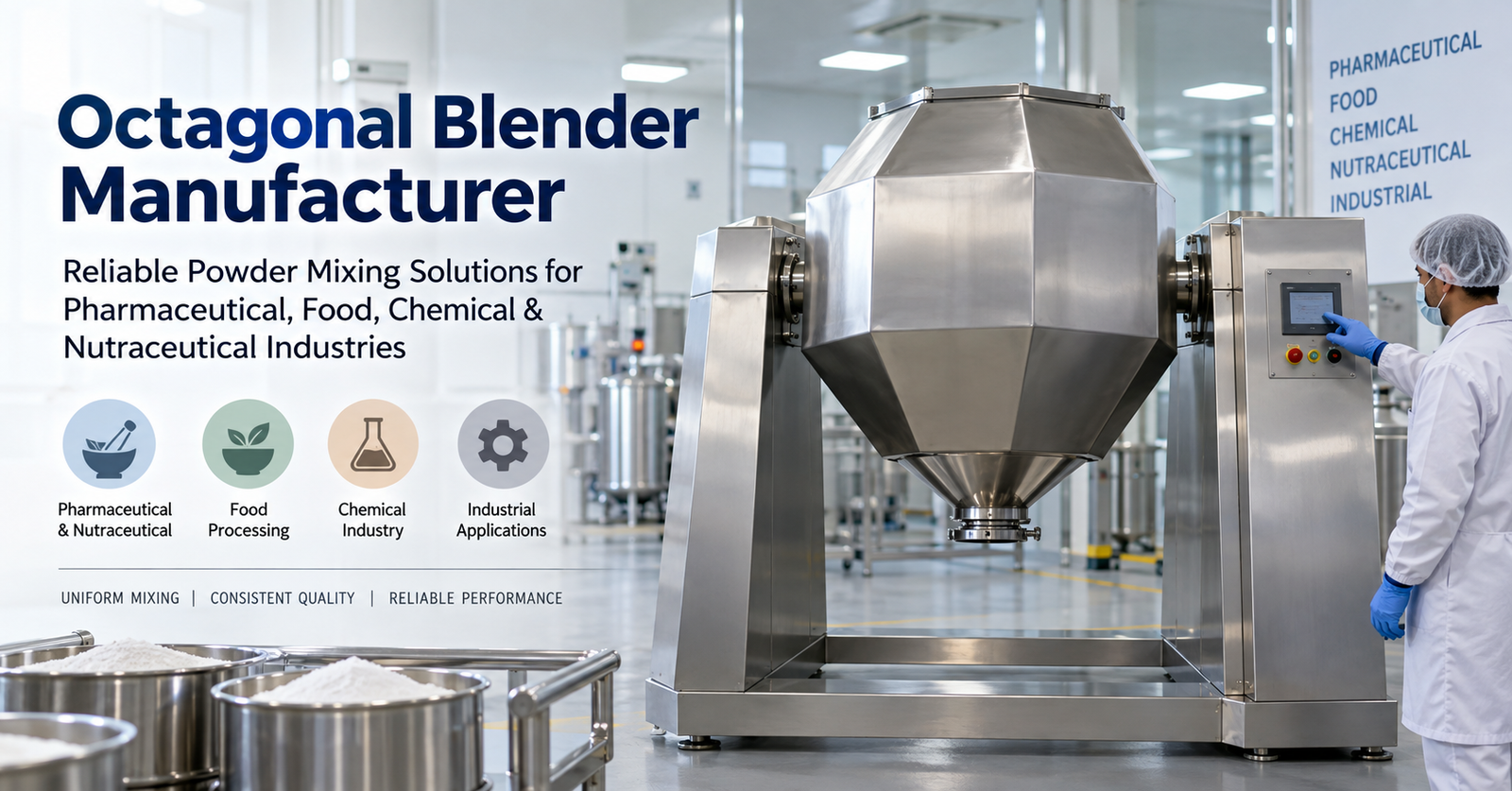
Choosing the right Octagonal Blender Manufacturer is important when consistent powder mixing, hygienic processing, and reliable batch performance are essential. Octagonal blenders are widely used for blending pharmaceutical powders, nutraceutical ingredients, food products, chemicals, and other dry materials. The right machine can help manufacturers achieve uniform batches while reducing manual handling, processing variation, and cleaning difficulties.
What is an Octagonal Blender Manufacturer?
An Octagonal Blender Manufacturer designs and manufactures octagonal-shaped powder blending machines used to achieve uniform mixing of dry materials.
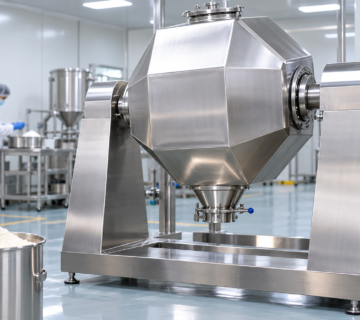
An octagonal blender typically uses a rotating container with an octagonal geometry. As the vessel rotates, the powder repeatedly moves, tumbles, and changes position. This creates a controlled mixing action without relying on high-speed agitation.
The equipment can be designed with suitable capacities, contact-part materials, drive systems, safety arrangements, and discharge configurations according to the process requirements.
AI Overview Summary
An octagonal blender is an industrial powder-mixing machine that uses controlled vessel rotation and tumbling action to achieve uniform blending. It is commonly used in pharmaceutical, nutraceutical, food, chemical, and other industries where consistent powder distribution, hygienic construction, easy cleaning, and repeatable batch processing are important.
Why is an Octagonal Blender Important?
Uniform powder distribution is critical in many manufacturing processes. Poor mixing can create differences in ingredient concentration, affecting product consistency and downstream processing.
For pharmaceutical and nutraceutical manufacturers, blender design also needs to support hygienic production and effective cleaning. WHO guidance emphasizes suitable equipment design, qualification, operation, cleaning, and maintenance as part of pharmaceutical manufacturing controls.
An octagonal blender can be useful when manufacturers need:
- Consistent dry powder blending.
- Controlled batch-to-batch processing.
- Reduced manual powder handling.
- Easier discharge and material transfer.
- Equipment suitable for hygienic production environments.
Key Features
The exact configuration varies by manufacturer and application, but common features include:
- Octagonal mixing vessel: Promotes repeated tumbling and movement of powder during rotation.
- Stainless steel construction: Product-contact surfaces can be selected according to hygiene and process requirements.
- Variable-speed operation: Allows the mixing cycle to be adjusted for different materials.
- Safety enclosure: Helps protect operators around moving mechanical components.
- Suitable discharge arrangement: Supports controlled transfer of the blended material.
- Customizable configuration: Capacity, controls, contact parts, and other options can be specified according to production requirements.
Benefits of an Octagonal Blender
The practical benefits depend on the powder characteristics and machine configuration, but manufacturers commonly select octagonal blenders for:
- Uniform mixing: Controlled tumbling can distribute different powder components throughout a batch.
- Gentle blending: The process can be suitable for materials where excessive shear is undesirable.
- Scalable production: Different working capacities can support laboratory, pilot, and production requirements.
- Better process consistency: Repeatable mixing parameters can help standardize batch operations.
- Hygienic processing: Appropriate stainless-steel construction and cleanable designs can support sanitation requirements.
- Reduced handling: Mechanical blending reduces dependence on manual mixing methods.
Applications
Octagonal blenders are used across several industries where dry materials need controlled and consistent mixing.
Pharmaceutical Industry
Pharmaceutical manufacturers may use blenders for powders, excipients, granules, and other dry formulations. Equipment selection should consider cleaning, material compatibility, validation requirements, and the specific manufacturing process.
Nutraceutical Industry
Nutraceutical manufacturers can use powder blenders for vitamin blends, mineral formulations, protein ingredients, herbal powders, and nutritional products.
Food Processing
Food manufacturers may use industrial blenders for dry ingredients, premixes, seasoning blends, powdered additives, and other formulations.
Chemical Industry
Chemical processing applications can include dry powders, additives, pigments, compounds, and other bulk materials where controlled mixing is required.
How to Choose the Right Octagonal Blender Manufacturer
Before purchasing equipment, evaluate the manufacturer as well as the machine itself.
- Check the required capacity: Select working volume based on actual batch size rather than only the total vessel volume.
- Understand your material: Consider particle size, density, flowability, moisture sensitivity, and whether the product is abrasive.
- Review construction material: Stainless-steel grade and surface finish should match the product and cleaning requirements.
- Ask about mixing parameters: Confirm rotation speed, mixing time, loading level, and discharge arrangement.
- Evaluate cleaning requirements: For pharmaceutical applications, equipment design should support the site’s cleaning procedures and validation approach. WHO guidance specifically recognizes equipment design as a factor in cleaning effectiveness.
- Check documentation and support: Ask about drawings, manuals, testing documentation, spare parts, installation support, and after-sales service.
For companies operating in western India, searches such as Octagonal Blender Manufacturer in Vadodara, Pharmaceutical Blender Manufacturer in Gujarat, Industrial Blender Manufacturer in Gujarat, Powder Blender Manufacturer in Gujarat, and Blender Machine Manufacturer in Ahmedabad can help identify suppliers serving the regional manufacturing market.
Common Mistakes to Avoid
Buyers often focus only on machine capacity and price. Other factors can be equally important.
- Choosing capacity without considering the recommended working volume.
- Ignoring powder characteristics and flow behavior.
- Selecting construction materials without considering product compatibility.
- Not checking cleaning and maintenance requirements.
- Failing to discuss discharge arrangements before ordering.
- Buying equipment without reviewing documentation and service support.
- Assuming every blender will produce the same mixing result for every powder.
A proper application discussion and, where necessary, product trials can help reduce these risks.
Conclusion
An octagonal blender can provide a practical solution for controlled dry powder mixing across pharmaceutical, nutraceutical, food, chemical, and industrial applications. The right machine should be selected according to material characteristics, batch size, hygiene requirements, mixing parameters, cleaning procedures, and long-term maintenance needs.
When evaluating an Octagonal Blender Manufacturer, discuss your application, required capacity, material specifications, and production conditions before finalizing the equipment. This helps ensure that the blender is matched to the actual process rather than selected only by general specifications.
FAQs
What is an Octagonal Blender Manufacturer?
An Octagonal Blender Manufacturer designs and produces octagonal-shaped blending machines used for mixing powders and dry materials. These machines use controlled vessel rotation and tumbling action to distribute ingredients throughout a batch. They are commonly used in pharmaceutical, nutraceutical, food, chemical, and other industrial manufacturing applications.
What are the benefits of an octagonal blender?
An octagonal blender can provide uniform powder mixing, controlled batch processing, reduced manual handling, and relatively gentle blending action. Depending on its construction and configuration, it can also support hygienic production and easier cleaning. Actual performance depends on material properties, loading level, mixing speed, and process conditions.
Where is an octagonal blender used?
Octagonal blenders are used in pharmaceutical, nutraceutical, food processing, chemical, and general industrial manufacturing. Typical applications include blending powders, dry ingredients, nutritional formulations, pharmaceutical excipients, chemical powders, seasoning mixes, and other bulk dry materials requiring consistent distribution.
How do I choose the right octagonal blender?
Start by evaluating batch size, working capacity, powder characteristics, required mixing time, material compatibility, construction material, discharge method, cleaning requirements, and available installation space. Pharmaceutical applications may also require appropriate documentation, qualification, and cleaning considerations. Discussing the actual product and process with the manufacturer is recommended.
Can an octagonal blender be customized?
Yes, octagonal blenders can commonly be configured according to application requirements. Depending on the manufacturer, customization may include capacity, stainless-steel construction, drive arrangement, speed control, discharge configuration, safety features, control systems, and other process-specific requirements. The exact options should be confirmed against the intended product and manufacturing process.
What material is best for an octagonal blender?
Stainless steel is commonly selected for product-contact parts because it can provide a hygienic, corrosion-resistant, and cleanable surface. The appropriate grade and finish depend on the product, chemical compatibility, cleaning process, and industry requirements. Pharmaceutical applications should be evaluated against the site’s applicable GMP and cleaning procedures.


No comment