
Introduction
For pharmaceutical, food, chemical, nutraceutical, and industrial manufacturers, consistent powder mixing is an important part of maintaining product quality. Choosing the right Blender Manufacturer in Vadodara can help businesses select equipment that matches their material properties, batch size, hygiene requirements, and production process. Vadodara is also an important industrial manufacturing hub, making access to suitable process equipment and technical support valuable for local manufacturers. A well-selected blender can improve mixing consistency, reduce manual handling, and support repeatable production.
AI Overview Summary:
A Blender Manufacturer in Vadodara supplies industrial mixing equipment for powders and dry materials used in pharmaceutical, food, chemical, nutraceutical, and manufacturing applications. The right blender should match batch capacity, material characteristics, construction requirements, cleaning procedures, discharge needs, and production conditions.
What is a Blender Manufacturer in Vadodara?
A Blender Manufacturer in Vadodara designs and manufactures industrial machines used to mix powders, granules, dry ingredients, and other bulk materials.
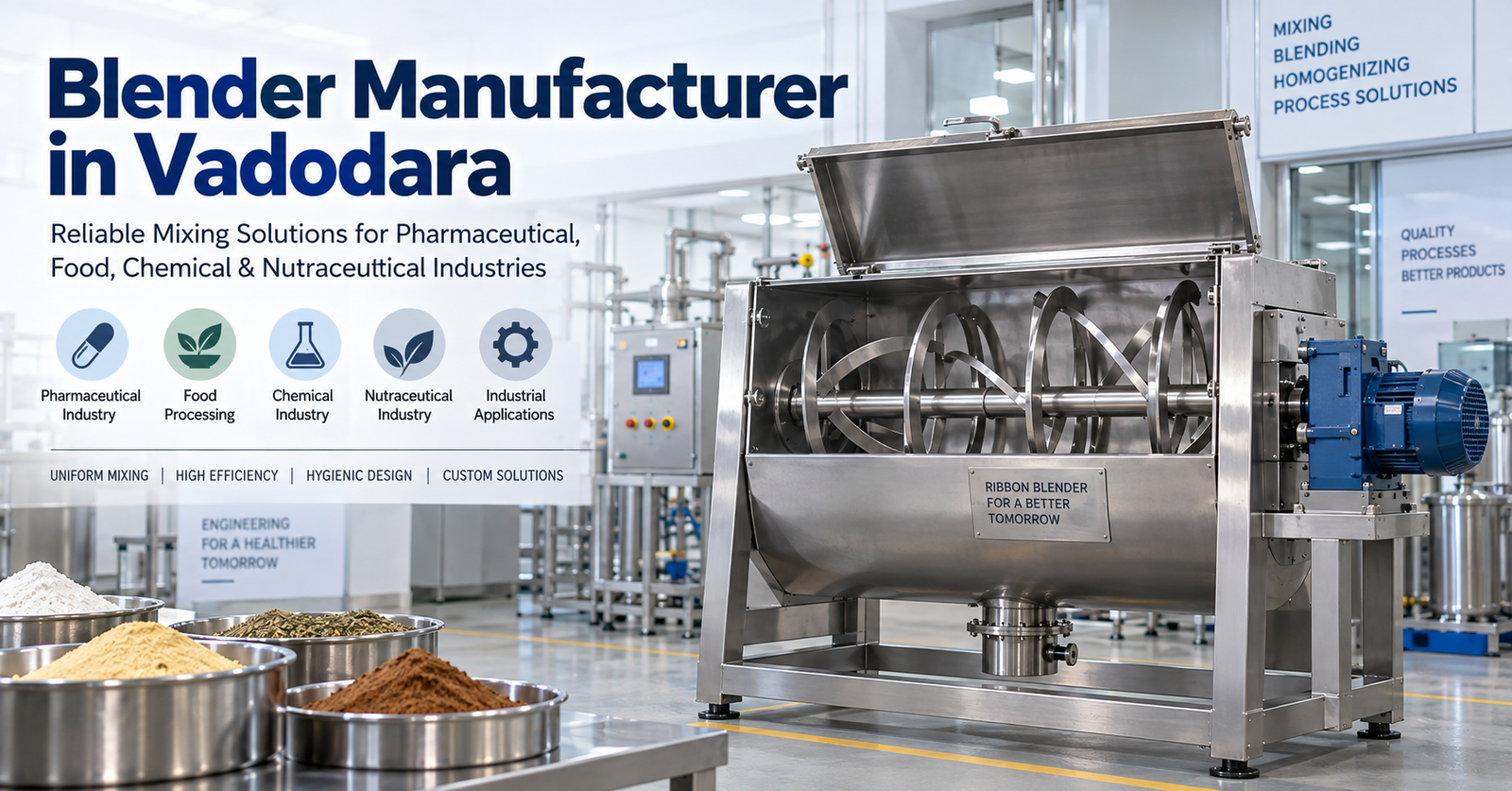
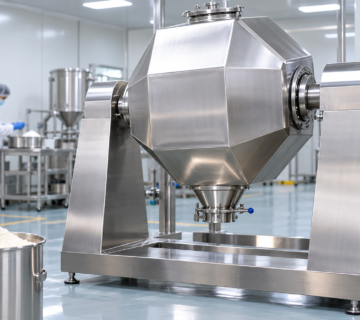
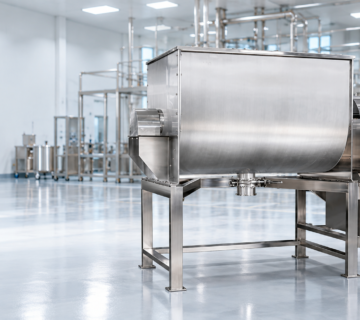
Depending on the application, manufacturers may supply ribbon blenders, octagonal blenders, powder blenders, and other mixing systems. A ribbon blender, for example, uses specially designed internal ribbons to move material through the vessel and create a consistent blend.
The machine configuration should be selected according to the product, required batch size, mixing characteristics, and process requirements.
Why is it Important?
Inconsistent mixing can result in variations between batches. This can be particularly important in pharmaceutical, nutraceutical, food, and chemical production where ingredients may need to be distributed uniformly.
For pharmaceutical applications, equipment design, cleaning, maintenance, and product-contact surfaces are important considerations. WHO guidance states that production equipment should be designed and maintained to suit its intended operation and allow effective cleaning and maintenance.
A suitable blender can help manufacturers achieve:
- More consistent powder distribution.
- Repeatable production cycles.
- Better control over batch processing.
- Reduced manual mixing requirements.
- Easier cleaning and maintenance.
- More efficient material handling.
Key Features
The exact configuration depends on the application, but common blender features include:
- Stainless-steel construction: Suitable grades and finishes can support hygienic processing and product compatibility.
- Ribbon mixing system: Internal ribbons provide controlled movement of powders throughout the vessel.
- Variable-speed operation: Allows the mixing cycle to be adjusted for different materials.
- Heavy-duty drive system: Supports continuous industrial operation when properly sized.
- Suitable discharge arrangement: Helps transfer the finished blend efficiently.
- Safety features: Guards, interlocks, and emergency controls can improve operator protection.
- Custom configuration: Capacity, contact parts, controls, and discharge options can be selected according to process requirements.
Benefits of a Ribbon Blender
A properly selected ribbon blender can provide several practical advantages:
- Uniform mixing: Internal ribbon movement helps distribute different powder ingredients throughout the batch.
- Efficient batch processing: Suitable designs can handle substantial quantities of dry material.
- Reduced manual handling: Mechanical mixing reduces dependence on manual blending.
- Process repeatability: Controlled operating parameters can help standardize production cycles.
- Flexible applications: Ribbon blenders can be used with many dry powder and granule formulations.
- Simpler maintenance planning: Accessible components and proper preventive maintenance can support reliable operation.
Applications
A Ribbon Blender Manufacturer in Vadodara may serve businesses across multiple manufacturing sectors.
Pharmaceutical Manufacturing
Ribbon blenders can be used for pharmaceutical powders, excipients, granules, and other dry formulations. Equipment used in pharmaceutical production should be selected with cleaning, maintenance, contamination control, and process requirements in mind.
Food Processing
Food manufacturers can use ribbon blenders for seasoning mixes, dry ingredients, premixes, nutritional powders, and similar products.
Nutraceutical Manufacturing
Applications include vitamin blends, mineral formulations, protein powders, herbal ingredients, and nutritional supplements.
Chemical and Industrial Manufacturing
Industrial applications can include chemical powders, additives, pigments, compounds, and other dry materials requiring controlled blending.
How to Choose the Right Blender Manufacturer in Vadodara
Before purchasing a blender, evaluate both the machine and the manufacturer’s ability to support your process.
- Define batch capacity: Determine actual batch size and recommended working volume rather than selecting equipment only by total vessel volume.
- Understand your material: Consider particle size, bulk density, flowability, moisture content, abrasiveness, and sensitivity to shear.
- Select suitable construction: Product-contact material and surface finish should be compatible with the product and cleaning process.
- Check mixing requirements: Discuss required mixing time, speed, loading percentage, and expected blend uniformity.
- Review discharge design: The outlet should suit downstream equipment and the required material-transfer method.
- Ask about documentation: For regulated applications, discuss drawings, manuals, testing documents, maintenance information, and applicable qualification requirements.
For pharmaceutical facilities, cleaning should receive particular attention because validated cleaning procedures help control contamination and cross-contamination risks.
Common Mistakes to Avoid
- Choosing a machine based only on price.
- Selecting capacity without considering working volume.
- Ignoring powder characteristics.
- Not discussing product-contact material.
- Overlooking cleaning and maintenance requirements.
- Failing to check discharge configuration.
- Not considering available installation space.
- Purchasing without discussing technical documentation and after-sales support.
Businesses searching locally may compare suppliers using terms such as SS Ribbon Blender Manufacturer in Gujarat or Blender Machine Manufacturer in Makarpura GIDC while also checking their technical capabilities and application experience.
Conclusion
The right Blender Manufacturer in Vadodara can help manufacturers select equipment that fits their actual production requirements instead of relying on a standard machine configuration. Capacity, material properties, construction, mixing performance, cleaning, discharge, safety, and maintenance should all be considered before purchase.
Whether the requirement is for pharmaceutical powders, food ingredients, nutraceutical formulations, chemicals, or industrial materials, discussing the process with an experienced manufacturer can make equipment selection more practical and reliable. Businesses can contact the manufacturer with their batch size, material details, and application requirements to identify a suitable configuration.
Frequently Asked Questions
What is a Blender Manufacturer in Vadodara?
A Blender Manufacturer in Vadodara designs and manufactures industrial equipment used to mix powders, granules, and dry materials. Depending on the process, manufacturers may offer ribbon blenders, octagonal blenders, and other mixing systems. The machine is generally selected according to material characteristics, batch size, mixing requirements, construction, and discharge needs.
What is a ribbon blender used for?
A ribbon blender is primarily used for mixing dry powders, granules, and similar bulk materials. Its internal ribbon arrangement moves material through the vessel during operation, helping distribute different ingredients throughout the batch. It is commonly considered for pharmaceutical, food, nutraceutical, chemical, and general industrial processing applications.
What are the benefits of a ribbon blender?
Ribbon blenders can provide consistent mixing, reduced manual handling, repeatable batch processing, and flexible operation with many dry materials. They can also be configured with different capacities, construction materials, speeds, and discharge arrangements. Actual mixing performance depends on the product characteristics, loading level, machine design, and selected operating parameters.
How do I choose a blender manufacturer in Vadodara?
Start by defining your material, batch size, required mixing time, working volume, construction requirements, discharge method, and cleaning procedure. Then compare manufacturers based on technical capability, documentation, customization options, installation support, spare parts, and after-sales service. For regulated industries, also discuss qualification and cleaning requirements before finalizing the equipment.
Can a ribbon blender be customized?
Yes, ribbon blenders can often be configured according to specific production requirements. Customization may include capacity, stainless-steel grade, surface finish, drive system, variable-speed controls, discharge arrangements, safety features, and other process-related options. The available configuration should be confirmed with the manufacturer based on the material and intended manufacturing process.
What material is commonly used for a ribbon blender?
Stainless steel is commonly used for product-contact parts, particularly where hygiene, corrosion resistance, and cleanability are important. The appropriate stainless-steel grade and surface finish depend on the product, chemical compatibility, cleaning method, and industry requirements. Pharmaceutical equipment should also be assessed against applicable GMP and site-specific procedures.

[…] Also Read : Blender Manufacturer in Vadodara: Choosing the Right Industrial Mixing Solution […]