
Welcome to the Blog Section of Shivanta Pharmatech
If you’ve ever stood on a shop floor watching a batch of powder come out uneven — some of it caked, some of it under-mixed — you already know why picking the right Octagonal Blender Manufacturer matters more than the brochure makes it sound. Powder blending looks simple from the outside. In practice, getting consistent, uniform mixing batch after batch depends heavily on the design of the machine and, just as much, on who built it.
This is where the choice of manufacturer becomes an important business decision rather than a routine purchase order. Whether you’re looking for pharmaceutical manufacturing equipment, nutraceuticals, food processing, or general chemical manufacturing, the blender you choose will directly affect your product quality, your validation paperwork, and your maintenance headaches for years to come.
In this article, we’ll walk through what an octagonal blender actually is, why its shape matters, what separates a good manufacturer from an average one, and what you should be asking before you sign a purchase order.
What Is an Octagonal Blender?
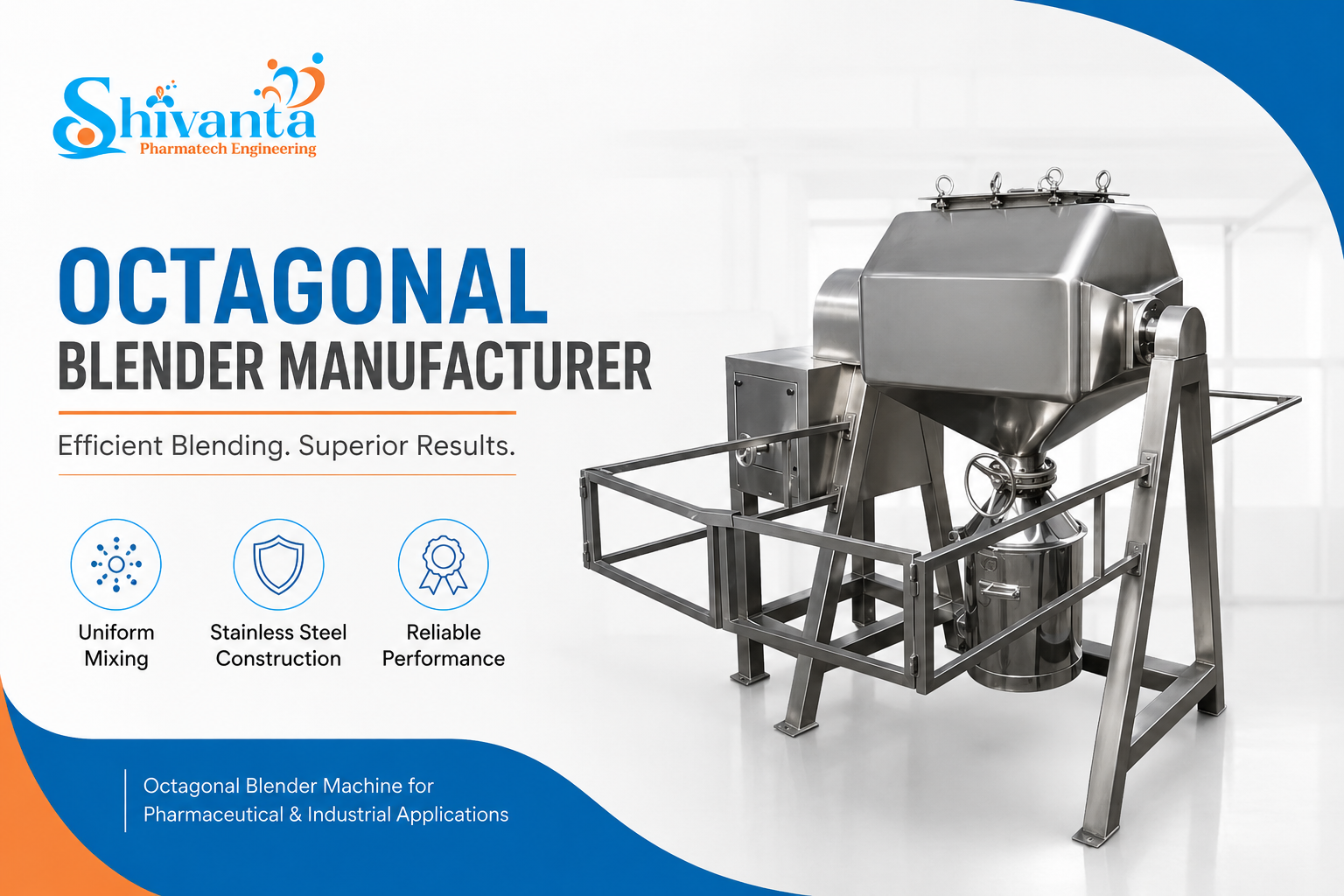
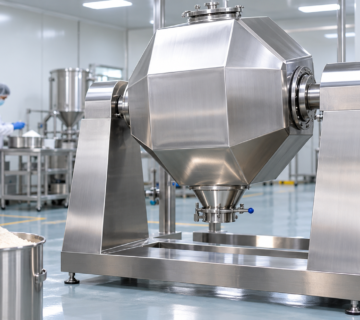
An octagonal blender is a type of dry powder mixing equipment shaped, as the name suggests, like an eight-sided vessel. It rotates on a horizontal axis, tumbling the material inside through repeated folding and cascading action until the blend reaches uniformity.
The octagonal shape isn’t just an aesthetic choice. Compared to a simple cylindrical or V-shaped drum, the multiple internal faces of an octagonal shell create additional folding points as the material tumbles. This tends to reduce dead zones — areas where powder just sits without mixing — and can improve mixing efficiency, particularly for materials with slightly different particle sizes or bulk densities.
How It Works
The basic operating principle is straightforward:
- The blender shell is charged with the powder or granules to be mixed (through a charging port or in some designs, directly loaded before mounting).
- The shell rotates slowly on its axis, usually driven by a geared motor.
- As the shell turns, gravity pulls the material down and across the internal faces, creating a continuous folding and tumbling motion.
- After a set number of rotations or a fixed blending time, the shell is stopped and the material is discharged, typically through a butterfly valve at the lowest point.
There’s no internal agitator or paddle in most designs — the mixing happens purely through the geometry and motion of the shell itself, which is one reason octagonal blenders are valued for gentle handling of friable or shear-sensitive materials.
Key Features to Look For
Not all octagonal blenders are built the same way, even if they look similar in photographs. A few features are worth paying close attention to:
- Material of construction — Stainless steel (usually SS 304 or SS 316 depending on the application) is standard for pharmaceutical and food-grade use, offering corrosion resistance and ease of cleaning.
- Hygienic design — Smooth internal welds, minimal crevices, and easily accessible charging and discharge points reduce the chances of material holdup and make cleaning validation simpler.
- Charging and discharge arrangement — Manual, semi-automatic, or fully automatic charging/discharging options depending on how the blender fits into your existing line.
- Safety interlocks — Guards and interlocking systems that prevent the machine from operating with an open access door or during loading/unloading.
- Drive system — A geared motor sized appropriately for the batch capacity, with smooth start-stop operation to avoid product segregation.
- Capacity range — Available in various working capacities to match lab-scale trials, pilot batches, or full commercial production runs.
Applications Across Industries
While the Best-quality octagonal blender for pharmaceutical manufacturing is the most talked-about variant, given how central dry powder mixing is to tablet and capsule manufacturing, the same basic machine finds use well beyond pharma:
- Pharmaceutical manufacturing — blending active pharmaceutical ingredients with excipients before compression or encapsulation
- Nutraceuticals and dietary supplements — mixing powder blends for capsules, sachets, and tablets
- Food processing — blending spice mixes, powdered nutrition products, and food additives
- Chemical and specialty chemical processing — homogenising powdered chemical formulations
- Cosmetics — mixing powder-based cosmetic and personal care formulations
The common thread across all these industries is the need for uniform mixing without degrading the material, and without introducing contamination — which is exactly what this blender design is meant to deliver.
Why Choosing the Right Octagonal Blender Manufacturer Matters
Here’s the thing that often gets underestimated: two octagonal blenders can look nearly identical on paper — same capacity, same material grade — and still perform very differently on the floor. The difference usually comes down to manufacturing quality and design experience, not the basic concept.
A few areas where manufacturer choice genuinely affects outcomes:
1. Build Quality and Material Standards
The grade of stainless steel used, the quality of welding and polishing, and the finishing of internal surfaces all affect how easily the machine passes cleaning validation and how long it holds up under daily use. Rough welds or poor polishing aren’t always visible at first glance but tend to cause problems during audits or after a year or two of operation.
2. Customisation Capability
Every production line is a little different. A manufacturer who can adjust charging height, discharge valve type, mounting orientation, or capacity to fit your specific layout saves you from working around a machine that doesn’t quite fit your process.
3. Capacity Options
You want a manufacturer offering a genuine range — from smaller units suitable for R&D or pilot batches up to larger industrial-scale blenders — so that as your production scales up, you’re not starting your equipment search from zero.
4. Safety Features
Interlocked guards, proper earthing, and controls that meet standard industrial safety practices aren’t optional extras; they’re basic expectations, especially in a pharmaceutical manufacturing environment where operator safety and product safety go hand in hand.
5. Hygienic and GMP-Friendly Design
If your end product falls under regulatory scrutiny, the blender’s design needs to support GMP requirements — smooth finishes, minimal product contact points that are hard to clean, and documentation that supports your validation process.
6. After-Sales Support
Equipment breakdowns are inevitable at some point. A manufacturer who’s responsive to spare parts requests and service calls makes a real difference to your downtime, especially compared to one who disappears after the invoice is settled.
7. Installation and Commissioning Support
Proper installation and commissioning — checking alignment, testing the drive system, and running trial batches — helps catch issues early rather than after the machine is already part of your daily production schedule.
A Quick Comparison Checklist Before You Buy
Before finalising any purchase, it helps to compare manufacturers against a simple checklist:
- Do they offer the material of construction (SS 304 / SS 316) you need?
- Can they customise capacity and configuration to your process?
- Do they provide documentation to support GMP and validation requirements?
- What is their typical lead time for manufacturing and delivery?
- Do they offer installation, commissioning, and operator training?
- How accessible is their after-sales service and spare parts support?
- Can they share references or past project experience relevant to your industry?
Working through this list with two or three manufacturers side by side usually makes the right choice fairly obvious.
Also Read :- Double Cone Blender Manufacturer in Vadodara – Complete Guide
Gujarat’s Role in Pharmaceutical and Industrial Manufacturing
Gujarat has long been one of India’s most significant hubs for pharmaceutical and chemical manufacturing, home to a dense cluster of formulation units, API manufacturers, and industrial processing plants. Cities like Vadodara, Ahmedabad, and Vapi host a large concentration of pharma and chemical companies, which in turn has supported the growth of a strong local ecosystem of process equipment manufacturers.
For a buyer, sourcing from within this ecosystem often means shorter lead times, easier factory visits before purchase, and manufacturers who already understand the regulatory and operational expectations common to the region’s pharma and industrial units. This is part of why searches for a Pharmaceutical Blender Manufacturer in Gujarat or an Industrial Blender Manufacturer in Gujarat have grown alongside the state’s manufacturing base.
About Shivanta Pharmatech
Shivanta Pharmatech is a pharmaceutical machinery manufacturer based in Vadodara, Gujarat, working on process equipment including octagonal blenders for pharmaceutical, nutraceutical, and industrial applications.
Being based in Vadodara — itself a well-established pharmaceutical and chemical manufacturing centre — puts Shivanta Pharmatech in a position to understand the practical, day-to-day requirements of manufacturers operating in this region, from hygienic design expectations to the pace at which production lines need equipment delivered and commissioned.
For manufacturers evaluating an Octagonal Blender Manufacturer in Vadodara or comparing options for a Pharmaceutical Blender Manufacturer in Gujarat, it’s worth having a direct conversation about your specific batch sizes, material handling needs, and hygienic design requirements — every production line has its own quirks, and a good manufacturer will want to understand yours before recommending a configuration.
Frequently Asked Questions
1. What is the difference between an octagonal blender and a V-blender?
Both are dry powder blending machines, but the internal geometry differs. The octagonal shape offers additional folding faces, which can help reduce dead zones compared to simpler shapes, while V-blenders rely on a two-armed splitting and rejoining action.
2. Which materials are typically used to construct pharmaceutical octagonal blenders?
Stainless steel — commonly SS 304 or SS 316 — is the standard choice for pharmaceutical and food-grade applications due to its corrosion resistance and cleaning ease.
3. Can an octagonal blender machine handle different batch sizes?
Yes, octagonal blenders are generally available across a range of capacities, from small lab or pilot-scale units to larger machines suited for commercial production. Always confirm the exact capacity range with your manufacturer.
4. Is an octagonal blender suitable for GMP-regulated pharmaceutical manufacturing?
When designed with hygienic features — smooth welds, accessible cleaning points, and appropriate documentation — an octagonal blender can support GMP-regulated manufacturing environments. It’s important to confirm these design details with your manufacturer before purchase.
5. What should I check before finalising an octagonal blender manufacturer?
Look at their material quality, customisation ability, safety features, GMP-friendly design, after-sales support, and installation/commissioning services. Comparing two or three manufacturers against these points usually makes the decision clearer.
In Conclusion
Choosing the right octagonal blender machine isn’t just about matching a capacity number to your batch size. It’s about finding a manufacturer whose build quality, design flexibility, and support you can rely on for years of daily operation. Whether you’re setting up a new pharmaceutical line, scaling up nutraceutical production, or looking for reliable industrial processing equipment, taking the time to properly evaluate your Octagonal Blender Manufacturer will save you time, cost, and operational headaches down the line.
If you’re currently comparing options for an octagonal blender for your facility, it’s worth reaching out to Shivanta Pharmatech to discuss your requirements and find a machine that’s the right fit for your process


[…] Read Our Latest Blog : How to Choose the Right Octagonal Blender Manufacturer for Pharmaceutical and Industrial Application… […]