
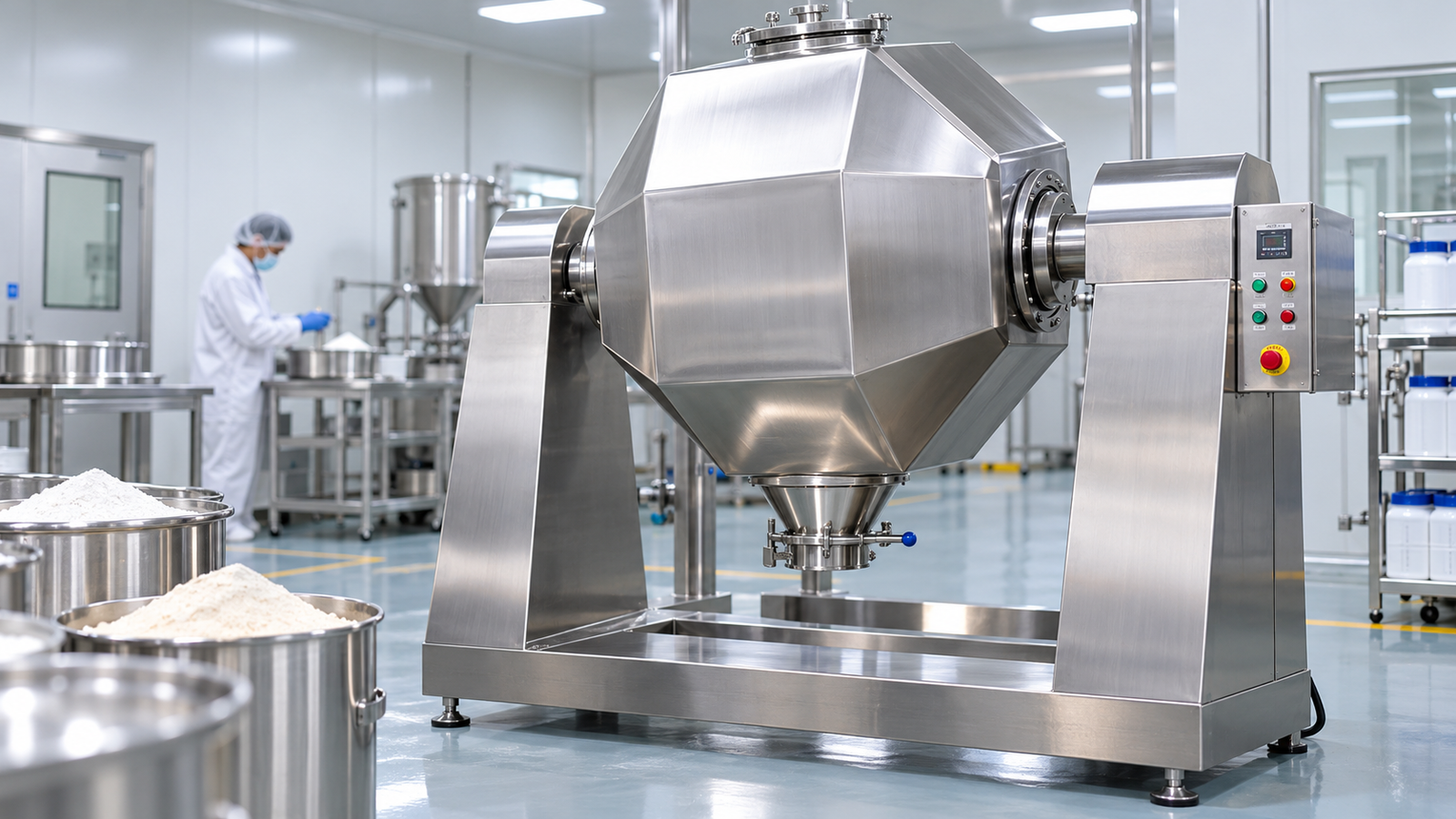
Choosing the right industrial blender is important when consistent powder mixing, product quality, and production efficiency matter. An Octagonal Blender Manufacturer designs and supplies blending equipment used for pharmaceutical powders, nutraceuticals, food ingredients, chemicals, cosmetics, and other dry materials. The right blender can improve batch uniformity, reduce manual handling, and support reliable production. For manufacturers, plant heads, and procurement teams, understanding the machine’s working principle, features, capacity, and material compatibility helps in selecting equipment that matches actual production requirements.
An octagonal blender is a dry powder mixing machine that uses a multi-sided rotating container to gently tumble and blend materials. It is commonly used for pharmaceuticals, food ingredients, chemicals, nutraceuticals, cosmetics, and other powder-processing applications where uniform mixing is required without excessive shear.
What is an Octagonal Blender?
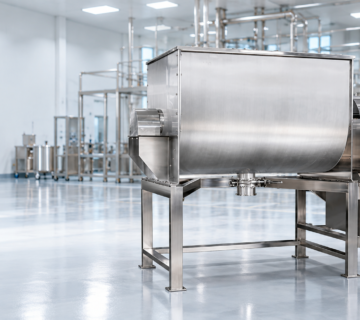
An octagonal blender is an industrial powder mixing machine designed to achieve uniform blending through controlled tumbling action. Its octagonal-shaped container rotates around a horizontal axis, causing powders and granules to repeatedly move, fall, and redistribute inside the vessel.
Unlike high-shear mixers, the machine generally works with a relatively gentle blending mechanism. This makes it suitable for applications where maintaining particle characteristics is important.
An experienced Pharmaceutical Blender Manufacturer in Gujarat can configure the equipment according to batch size, material properties, production requirements, and plant conditions.
Why is an Octagonal Blender Important?
Uniformity is one of the most important requirements in powder processing. Poor mixing can create variations in active ingredients, excipients, flavors, colors, or other components.
An octagonal blender helps manufacturers achieve more consistent batches while reducing repetitive manual mixing. It can also be integrated into larger production lines for controlled and repeatable processing.
The equipment is particularly useful when manufacturers need:
- Consistent powder or granule distribution
- Repeatable batch-to-batch mixing
- Reduced manual material handling
- Controlled production cycles
- Hygienic and easy-to-clean equipment
- Scalable blending capacity
Key Features of an Octagonal Blender
The exact configuration varies according to the application, but common features include:
- Octagonal blending vessel: Provides effective tumbling and redistribution of powders.
- Stainless steel construction: Suitable grades can support hygienic processing and corrosion resistance.
- Variable-speed operation: Allows the mixing speed to be adjusted according to material characteristics.
- Baffle arrangement: Can improve powder movement and blending efficiency.
- Safety guards: Help protect operators around moving components.
- Easy discharge system: Supports controlled transfer of the finished blend.
- PLC or control panel options: Can help operators manage mixing time and operating parameters.
Benefits of an Octagonal Blender
For powder-processing plants, the practical benefits can include:
- Improved blend uniformity: Helps distribute ingredients consistently throughout a batch.
- Gentle mixing: Useful for materials that can be affected by excessive shear.
- Reduced processing effort: Minimizes dependence on manual powder mixing.
- Better production consistency: Repeatable operating parameters can support standardized batches.
- Flexible applications: One machine can be used for different powder and granule formulations when properly designed.
- Simpler material handling: Closed or controlled transfer arrangements can reduce unnecessary exposure during processing.
Applications of an Octagonal Blender
Octagonal blenders are used across several industries where dry powders or granules need controlled mixing.
Typical applications include:
- Pharmaceutical and API manufacturing
- Nutraceutical and supplement production
- Food and ingredient processing
- Chemical and specialty chemical production
- Cosmetic and personal care manufacturing
- Ayurvedic and herbal formulations
- Agrochemical and fertilizer processing
- Paint and pigment processing
- Industrial powder processing
- R&D and pilot-scale formulation development
For plants located in Gujarat, companies may evaluate an Industrial Blender Manufacturer in Gujarat based on manufacturing capability, technical support, customization, and after-sales service.
How to Choose the Right Octagonal Blender
Selecting a blender only by capacity can result in poor equipment performance. Consider these factors before purchasing:
1. Understand the Material
Check powder characteristics such as bulk density, particle size, flowability, moisture sensitivity, and tendency to segregate.
2. Select the Correct Capacity
Consider both working volume and maximum vessel volume. The required fill level depends on the material and desired mixing performance.
3. Check Construction Material
For pharmaceutical, food, and sensitive applications, stainless steel construction and the appropriate surface finish may be important.
4. Evaluate Mixing Requirements
Discuss required blend uniformity, mixing time, speed range, and whether the material is free-flowing, cohesive, or fragile.
5. Consider Discharge Requirements
The discharge arrangement should match the downstream process, such as filling, compression, packing, or further processing.
6. Check Customization and Support
A reliable Powder Blender Manufacturer in Gujarat should be able to discuss machine configuration, controls, safety requirements, installation, and maintenance support.
Common Mistakes to Avoid
Buyers sometimes select equipment based only on advertised capacity or price. This can lead to unsuitable machines for the actual powder characteristics.
Other common mistakes include ignoring bulk density, selecting an incorrect fill level, overlooking cleaning requirements, failing to discuss discharge arrangements, and not checking whether the manufacturer can provide suitable customization.
Procurement teams should also confirm technical documentation, testing requirements, warranty terms, installation support, and spare-parts availability before finalizing a machine.
Conclusion
An octagonal blender can be a practical solution for manufacturers that require consistent and controlled mixing of powders and granules. Its applications extend across pharmaceuticals, APIs, nutraceuticals, food, chemicals, cosmetics, herbal products, agrochemicals, and other powder-processing industries.
When evaluating an Octagonal Blender Manufacturer, focus on more than machine capacity. Material compatibility, construction quality, mixing requirements, discharge design, controls, customization, and technical support all influence long-term performance. Manufacturers can discuss their specific application and production requirements with a qualified equipment supplier before selecting the final configuration.
Frequently Asked Questions
What is an octagonal blender used for?
An octagonal blender is mainly used for mixing dry powders and granules to achieve a consistent blend. It is commonly found in pharmaceutical, nutraceutical, food, chemical, cosmetic, herbal, agrochemical, and other powder-processing industries where controlled and repeatable mixing is required.
How does an octagonal blender work?
The blender works by rotating an octagonal-shaped vessel around a horizontal axis. As the vessel rotates, the material tumbles, falls, and redistributes throughout the container. This repeated movement helps combine different powders or granules into a more uniform mixture.
What industries use octagonal blenders?
Octagonal blenders are used in pharmaceutical and API manufacturing, food processing, nutraceuticals, cosmetics, chemicals, specialty chemicals, Ayurvedic products, agrochemicals, fertilizers, pigments, and industrial powder processing. They can also be useful for R&D and pilot-scale manufacturing.
How do I choose the right octagonal blender?
Consider material properties, batch size, working capacity, required blend uniformity, mixing time, construction material, discharge arrangement, cleaning requirements, controls, and available plant space. Discussing these factors with a qualified manufacturer helps ensure that the selected machine matches the production process.
Can an octagonal blender be customized?
Yes, industrial blenders can often be configured according to application requirements. Possible considerations include capacity, stainless steel grade, surface finish, discharge design, speed control, safety features, automation, and other plant-specific requirements. The available customization depends on the manufacturer and intended application.
What material is commonly used to manufacture an octagonal blender?
Stainless steel is commonly used for blender construction, particularly in pharmaceutical, food, nutraceutical, and hygienic processing applications. The appropriate stainless steel grade and surface finish depend on the product, cleaning process, corrosion conditions, regulatory requirements, and overall plant design.


No comment